












Dog Food Formats Compared: Fresh, Kibble, Canned, Raw, and Freeze-Dried

Dog food comes in six main formats: fresh (gently cooked), kibble, canned (wet), raw, freeze-dried, and dehydrated. What separates them is how much heat and processing the ingredients go through and how much moisture survives it, and that drives everything else: cost, shelf life, storage, and digestibility. None is automatically the "right" one; each has a real, legitimate use case, and the honest answer depends on your dog, your budget, and your kitchen. This guide lines up all six side by side, then links to a deeper, sourced comparison for each pairing.
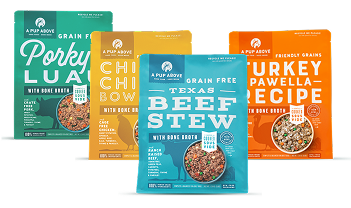
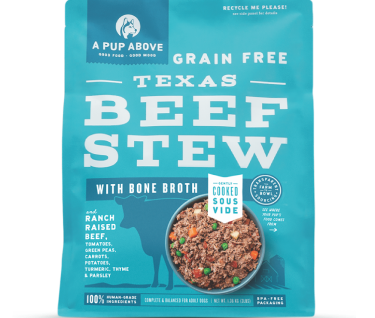
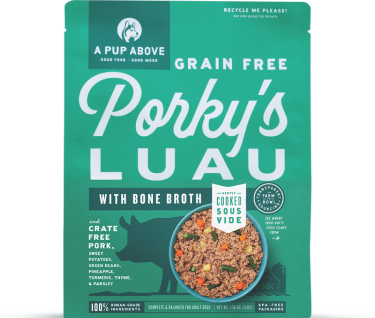
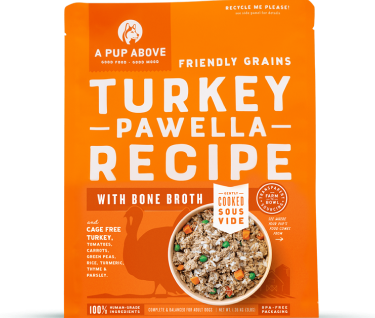
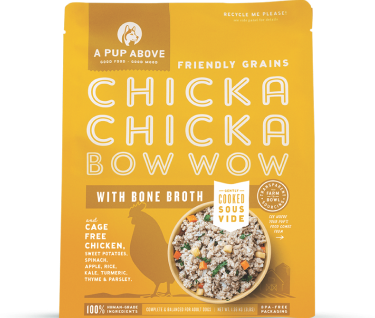
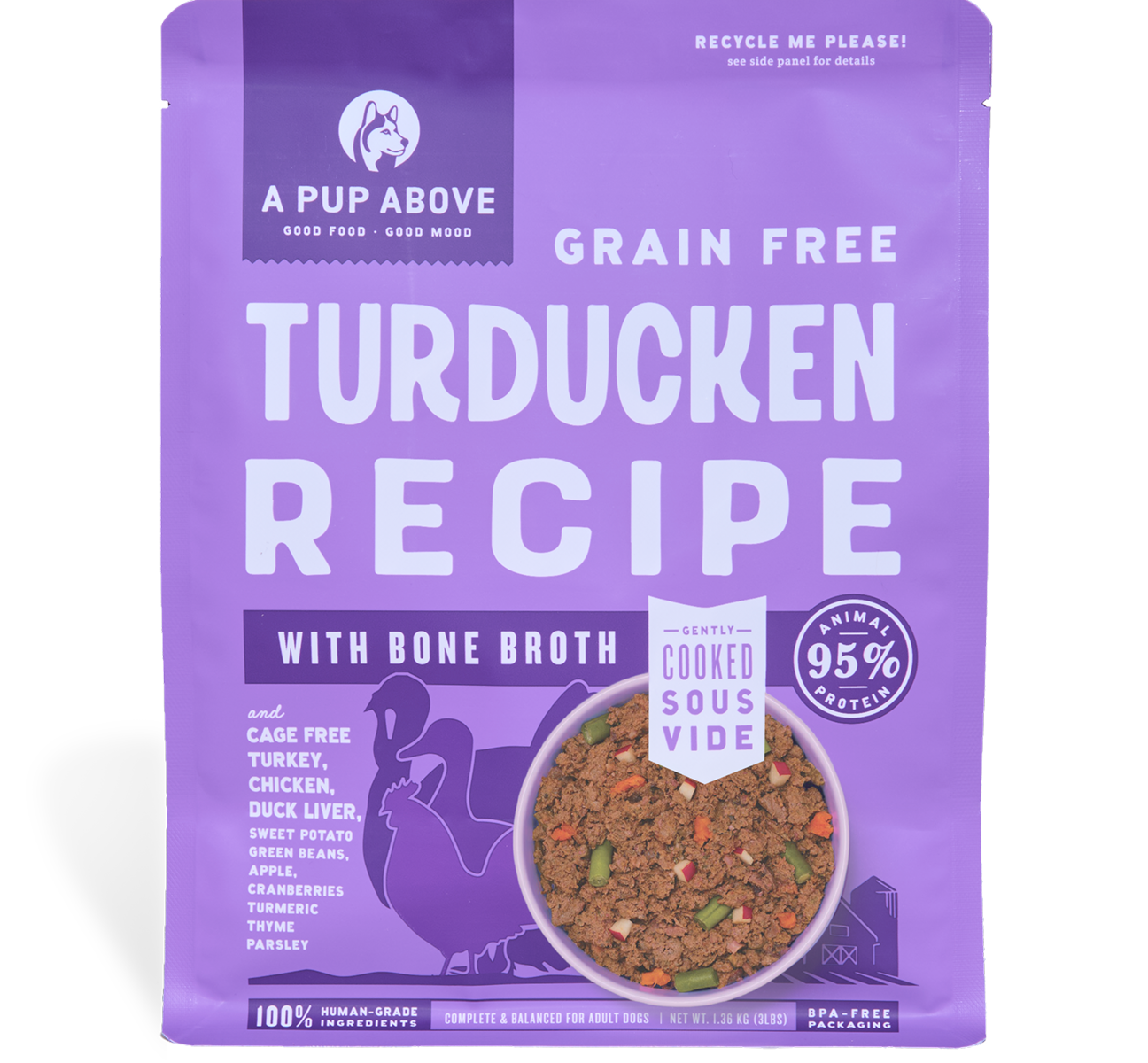
A Pup Above makes fresh food: real meat, non-GMO vegetables, and real bone broth, gently cooked sous-vide from human-grade ingredients, sold frozen. This page is the map, not a sales pitch, an honest side-by-side look that includes the parts that don't favor fresh food.
What Are the Six Main Dog Food Formats?
- Fresh (gently cooked). Real, whole ingredients cooked at low, controlled temperatures, such as sous-vide, then kept refrigerated or frozen.
- Kibble. Meat, meal, grains or starches, and fats extruded under high heat and pressure into a dry pellet.1
- Canned (wet). Meat or meat by-products with broth or gravy, sealed in the can and heat-sterilized (retort processing).2
- Raw. Ground or cubed raw meat, organs, and often bone, never cooked, sold frozen and thawed before serving.
- Freeze-dried. Flash-frozen, then dried in a vacuum chamber so ice turns straight to vapor (sublimation), leaving the food very low in moisture.3
- Dehydrated. Dried with a steady stream of warm air over several hours, lower-heat than extrusion or canning but still not classified as cooking.3
How Do All Six Formats Compare Side by Side?
| Fresh, gently cooked | Kibble | Canned (wet) | Raw | Freeze-dried | Dehydrated | |
|---|---|---|---|---|---|---|
| How it's made | Real ingredients cooked at low, controlled temperature (e.g., sous-vide) | Extruded under high heat and pressure1 | Cooked and sealed in the can under heat and pressure (retort)2 | Not cooked; ground or whole cuts, thawed before feeding | Flash-frozen, then dried under vacuum (sublimation)3 | Dried with warm air over several hours3 |
| Moisture (as fed) | High, closer to a home-cooked meal | Roughly 10–12%4 | Roughly 75–78%4 | High, similar to raw meat | Roughly 2–3%3 | Roughly 10–12%3 |
| Built-in pathogen-reduction step | Yes, cooking | Yes, extrusion heat | Yes, retort heat | No, relies on handling56 | No, freezing and drying aren't cooking5 | No, drying heat isn't cooking heat5 |
| Shelf life & storage | Months frozen; days once thawed, refrigerated | 12–18 months unopened, room temperature | 1–2+ years unopened, room temperature; a few days once opened, refrigerated | Months frozen; use quickly once thawed | 12–18 months, room temperature; often rehydrated before serving | 12–18 months, room temperature; often rehydrated before serving |
| Digestibility | 93%+ in third-party feeding studies7 | Varies by formula and processing1 | Varies by recipe and processing2 | Limited independent comparative data | Limited independent comparative data | Limited independent comparative data |
| Everyday cost | Higher; roughly $11–$15 a pound for A Pup Above (real numbers below) | Lowest of the six8 | Cheap per can, often more per calorie8 | High, a range similar to fresh8 | Premium, similar to other lightly processed formats | Premium, similar to other lightly processed formats |
Two patterns stand out. Moisture and shelf stability move together: the wetter the food, the shorter its unrefrigerated life, which is why canned and fresh need a fridge or freezer while the drier formats sit fine in the pantry. Cooking is the other dividing line: fresh, kibble, and canned all get a heat step that reduces pathogens as a byproduct; raw, freeze-dried, and dehydrated don't, a food-safety question worth taking seriously in the kitchen.
Which Dog Food Format Is Most Digestible?
Third-party feeding studies measured 93%+ apparent digestibility in A Pup Above's gently cooked recipes.7 Put another way, A Pup Above fresh food is up to 50% more digestible than standard kibble.7 On the Merck Veterinary Manual's digestibility scale, below 80% is low, 80–85% average, 86–93% high, and above 93% very high.9 Kibble digestibility varies by formula, since shear and moisture levels during extrusion measurably shift how much starch a dog can digest, even within the same recipe.1 Canned food digestibility varies similarly by recipe and processing.2 For raw, freeze-dried, and dehydrated food, there isn't strong independent research comparing them head-to-head against cooked whole-food diets.
For more on what digestibility means and why it matters, see highly digestible dog food.
What Does Each Format Actually Cost?
A 2022 survey of real diets by Tufts University's Cummings School of Veterinary Medicine found that feeding only wet food costs roughly five times what dry food costs for the same dog, and that fresh food (six popular brands surveyed) cost four to six times the most expensive dry food.8 Raw and freeze-dried land in that same expensive tier; dehydrated sits there too, since lightly processing and shelf-stabilizing food costs more than mass-extruding it.
"There is a good quality diet available at nearly every price point for a healthy pet." Dr. Cailin R. Heinze, VMD, MS, DACVIM (Nutrition), Tufts Cummings School of Veterinary Medicine8
Across A Pup Above's seven recipes, a 3lb x 2 bag (6lb total) runs $75.98 to $87.98 depending on recipe, and a 7lb x 2 bag (14lb total) runs $157.98 to $191.98, current pricing on the fresh dog food page as of September 2026, roughly $11 to $15 a pound. That's a real premium: real meat and cold-shipped production cost more than a shelf-stable bag at room temperature. If cost is the deciding factor, kibble is the most budget-friendly format, and using fresh food as a topper gets some of the benefit without the full cost. The sampler pack is the lowest-cost way to test recipes first. For the full math by dog weight, see what fresh dog food actually costs.
Is Raw or Freeze-Dried Dog Food Safe?
Both can be, with careful handling. Freezing and low-heat drying don't reach pathogen-killing temperature, so both are handled as raw for food-safety purposes.5 In a two-year study, the FDA's Center for Veterinary Medicine tested 196 samples of commercially available raw pet food and found 15 positive for Salmonella (about 8%) and 32 positive for Listeria monocytogenes (about 16%); by contrast, only 2 of the 480 dry and semi-moist dog food samples tested in the same study came back positive (1 Salmonella, 1 a Listeria species), a far lower positivity rate.6 The AVMA's policy is direct: it discourages feeding cats and dogs "any animal-source protein that has not first been subjected to a process to eliminate pathogens, because of the risk of illness to cats and dogs, as well as humans."5
None of this makes raw or freeze-dried food reckless, only more demanding in the kitchen: thaw in the fridge rather than on the counter, use a dedicated cutting board and bowl, and wash hands and surfaces thoroughly. Fresh and kibble both build in a pathogen-reduction step; the tradeoff is kibble's more processed profile, or fresh's higher price, against less kitchen risk. For the fuller version, see freshly cooked vs. raw dog food.
How Do You Choose the Right Format for Your Dog?
A few starting points, based on what actually varies dog to dog:
- Picky eaters tend to respond best to fresh or canned food; both are more aromatic than kibble, freeze-dried, or dehydrated, and smell is most of what wins over a hesitant dog.
- Sensitive stomachs generally do best on simple, highly digestible formats, fresh food's strongest use case.
- Budget points toward kibble first, with fresh food as a topper if you want some of the benefit without the full cost.
- Freezer space rules out raw and fresh for some households; kibble, freeze-dried, and dehydrated are the shelf-stable options.
- Households with young kids, older adults, or a compromised immune system generally do better with a cooked format (fresh or kibble), since both build in a pathogen-reduction step the others don't have.
Whichever format you land on, look for "complete and balanced" on the label: it means the food meets an AAFCO nutrient profile or passed a feeding trial, with the same minimums regardless of format.10
Want a Deeper Comparison? Start Here
Each pairing below gets its own full, sourced breakdown:
- Fresh vs. kibble
- Canned vs. fresh
- Freshly cooked vs. raw
- Raw-frozen vs. gently cooked, and where kibble fits
Comparing Specific Brands, Not Just Formats
Everything above compares categories, not companies. If you already know you want fresh, gently cooked food and you're deciding which brand to order, best fresh dog food: how to actually choose covers the criteria that separate good fresh food from marketing, and fresh dog food brands compared lines up several well-known brands factually, sources included.
Where Does A Pup Above Fit?
A Pup Above makes human-grade, sous-vide, gently cooked fresh dog food across seven recipes, each finished with real bone broth and sold frozen in 3lb and 7lb bags on the fresh dog food page. It sits in the fresh, gently cooked row above: cooked (with a built-in pathogen-reduction step), higher in moisture than dry formats, stored frozen, and priced at a premium that reflects real ingredients and cold-shipped production. Browse the full fresh food lineup, or start with the sampler pack to test recipes first.
It's also sold in stores; see where to buy fresh dog food.
Frequently Asked Questions
What's the difference between fresh dog food and kibble? Fresh food is made from real, whole ingredients and gently cooked at low temperatures (A Pup Above's recipes are cooked sous-vide); kibble is extruded under high heat and pressure into a dry pellet. Fresh generally means less processing and, when the brand is human-grade, a higher ingredient standard; kibble costs less per day and stores longer at room temperature. See the full fresh vs. kibble comparison.
Is raw dog food the same as fresh, gently cooked dog food? No. Both are typically sold frozen and made from real ingredients, but raw is never cooked, while gently cooked food goes through a sous-vide step that doubles as a pathogen-reduction step. See the freshly cooked vs. raw comparison.
Is canned (wet) dog food the same as fresh dog food? No. Canned food is cooked and sealed inside the can using high-heat retort processing; fresh food is gently cooked and kept refrigerated or frozen, never sterilized in a sealed can. See the canned vs. fresh comparison.
What's the difference between freeze-dried and dehydrated dog food? Freeze-dried food is flash-frozen, then dried under vacuum at very low temperatures, leaving it drier (roughly 2–3% moisture) and more porous. Dehydrated food is dried with warm air over several hours, leaving more moisture behind (roughly 10–12%) and a denser, chewier texture. Neither reaches cooking temperature, so both get the same food-safety care as raw.35
Does A Pup Above sell kibble, canned, raw, freeze-dried, or dehydrated dog food? No. A Pup Above's current lineup is gently cooked, sous-vide fresh food only, across seven recipes, sold frozen. This guide describes the other formats factually because they're common questions on the way to deciding what to feed, not because A Pup Above sells them.
Sources
- "Extrusion Processing Modifications of a Dog Kibble at Large Scale Alter Levels of Starch Available to Animal Enzymatic Digestion," National Library of Medicine (PMC): https://pmc.ncbi.nlm.nih.gov/articles/PMC8621379/ ↩
- "Nutritional Requirements of Small Animals," Merck Veterinary Manual: https://www.merckvetmanual.com/management-and-nutrition/nutrition-small-animals/nutritional-requirements-of-small-animals ↩
- "Freeze-Dried Dog Food vs. Dehydrated Dog Food," Union Lake Veterinary Hospital: https://unionlakeveterinaryhospital.com/blog/freeze-dried-dog-food-vs-dehydrated-dog-food ↩
- "What Is the Difference Between Dry, Semi-Moist and Wet Pet Foods?," Purina Institute: https://www.purinainstitute.com/centresquare/understanding-pet-food/what-is-the-difference-between-dry-semi-moist-and-wet-pet-foods ↩
- "Raw or Undercooked Animal-Source Protein in Cat and Dog Diets," American Veterinary Medical Association: https://www.avma.org/resources-tools/avma-policies/raw-or-undercooked-animal-source-protein-cat-and-dog-diets ↩
- "Get the Facts! Raw Pet Food Diets can be Dangerous to You and Your Pet," U.S. Food and Drug Administration: https://www.fda.gov/animal-veterinary/animal-health-literacy/get-facts-raw-pet-food-diets-can-be-dangerous-you-and-your-pet ↩
- Third-party studies measure A Pup Above meals at 93%+ digestible; published kibble digestibility can be as low as 64%. Gross, K.L., et al., Small Animal Clinical Nutrition, 5th ed., Mark Morris Institute, 2020. ↩
- "Expensive eats? Comparing the costs of different types of dog food," Petfoodology (Tufts Cummings School of Veterinary Medicine), Cailin R. Heinze, VMD, MS, DACVIM: https://sites.tufts.edu/petfoodology/2022/03/21/pet-food-costs-by-type/ ↩
- "Nutritional Requirements of Small Animals," Merck Veterinary Manual: https://www.merckvetmanual.com/management-and-nutrition/nutrition-small-animals/nutritional-requirements-of-small-animals ↩
- "'Complete and Balanced' Pet Food," U.S. Food and Drug Administration: https://www.fda.gov/animal-veterinary/animal-health-literacy/complete-and-balanced-pet-food ↩