

Is Fresh Dog Food Worth It?
For a lot of dogs, yes, and for specific, checkable reasons: real digestibility gains, ingredients you can actually recognize, and a genuine fix for picky eating that another reformulated bag of kibble usually isn't. It is not, however, a requirement for a healthy dog to thrive, and it costs several times more than kibble for the same calories. The honest answer depends on what's actually going on with your dog: a picky eater or a sensitive stomach tips the scale one way, a tight budget and a dog that already does fine on kibble tips it the other.
Every fresh food brand, including us, has an obvious reason to say yes. This page is the more useful version: the real benefits, the real downsides, what it actually costs, and what customers who've fed it for months, not days, actually say.
What Are the Real Benefits of Fresh Dog Food?
The case for fresh food holds up best on a few specific points, not a vague "it's just better" claim.
- Digestibility. In third-party feeding studies, our gently cooked, human-grade recipes measured 93%+ digestibility. A Pup Above fresh food is up to 50% more digestible than standard kibble.1
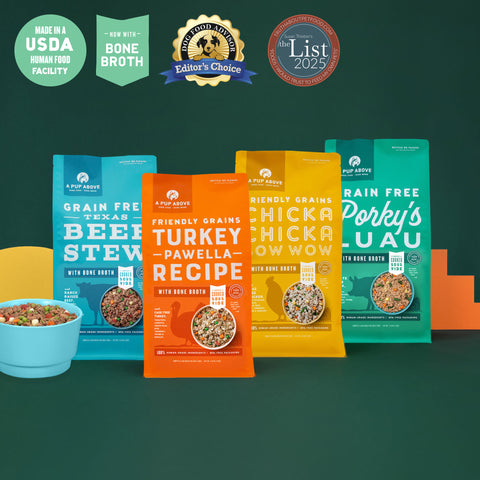
- Ingredients you can actually recognize. Human-grade is a legal standard, not a marketing phrase. AAFCO requires that every ingredient and the finished product be fit for human consumption and made in a facility licensed and inspected for human food.2 A Pup Above's recipes use real meat, real bone broth, and non-GMO vegetables, gently cooked sous-vide instead of extruded, in place of the rendered meal and additives common in conventional kibble. See what human-grade actually means for the full standard.
- Picky eating. This is the single most common reason A Pup Above customers say they switched. Picky eating shows up in 281 of 1,212 approved customer reviews (23%), more than three times any other topic, and higher moisture with a stronger, real-food aroma than dry kibble is most of why.3 Our guide to feeding a picky eater covers what to try first.
- Coat and energy, according to customers. In a newer, still-growing batch of 47 reviews with more detailed feedback, 21 noted a visible improvement in their dog's coat or energy after switching.3 That's a self-reported early trend in a small sample, not a clinical claim, and it's one we'll keep updating as more structured reviews come in.
- Sensitive stomachs. Digestion and stool-related comments appear in 59 combined mentions across the review corpus,3 and lower processing with higher moisture is a common reason fresh food comes up for dogs with ongoing GI sensitivity. If that's the main reason you're looking at fresh food, the sensitive stomach collection is the more targeted starting point.
What Are the Real Downsides of Fresh Dog Food?
The tradeoffs are just as real.
- Cost. This is the big one: several times what kibble costs for the same calories. The real numbers, and the ways to bring them down, are below.
- Fridge or freezer space, and a routine change. Fresh food ships cold and lives in the fridge or freezer, not a pantry shelf. Defrosting on a schedule is a genuine adjustment, and one of the most common practical questions customers ask before switching.3
- It's not proven to outperform every other complete diet for an average healthy dog. This is the part fresh food marketing, ours included, tends to skip. Dr. Cailin R. Heinze, VMD, MS, DACVIM (Nutrition), of Tufts Cummings School of Veterinary Medicine, put it plainly in a widely referenced comparison of pet food costs and types:
> "The truth is that there are minimal scientific data to suggest a benefit of one of these diet types over others for an otherwise 'average' healthy dog." > Dr. Cailin R. Heinze, VMD, MS, DACVIM (Nutrition), Tufts Cummings School of Veterinary Medicine4
That doesn't mean fresh food does nothing.1 It means a healthy dog already doing well on a complete and balanced kibble isn't missing something essential. Fresh food's clearest wins are the situations above: picky eaters, sensitive stomachs, and pet parents who want to recognize every ingredient, not a universal requirement.
- A short transition period. Most dogs do best switching gradually over about a week rather than all at once. Actively refusing fresh food is uncommon, moist and aromatic tends to be the easier sell, but a slow introduction lowers the risk. See our transition guide for the day-by-day schedule.
Is Fresh Dog Food Right for Your Dog?
Put plainly, here's how that tends to shake out:
| Fresh food is probably worth trying | It's probably not the first move |
|---|---|
| Your dog is picky, skipping meals, or bored of the same kibble | Your dog eats a complete and balanced kibble without complaint and budget is tight |
| Your dog has a sensitive stomach, frequent soft stool, or a diagnosed food sensitivity | You don't have consistent fridge or freezer space for a rotating supply |
| You want to recognize every ingredient in the bowl instead of decoding a label | Cost is the deciding factor and a full switch doesn't fit right now (a topper still might) |
| You're already using it as a topper and want to see if a full switch helps more | Your dog is on a specific prescription diet (check with your vet before switching) |
If your dog lands mostly in the left column, the lowest-risk way to find out is a topper portion or the sampler pack, not a full-size bag of a recipe you haven't tested yet. Browse the full Fresh Dog Food lineup, seven recipes across two sizes, or see the whole fresh food collection to compare them side by side.
Is Fresh Dog Food Worth the Cost?
Here's the number that actually matters. A Pup Above runs about $11 to $15 a pound, which works out to roughly $4 to $5 a day for a small dog and $20 to $30 a day for a large dog at full feeding. That's several times what most kibble costs for the same calories: budget kibble typically runs about $0.50 to $1.50 a day for a medium dog, and premium formulas run closer to $1.50 to $3.50.5 A 2022 Tufts University Cummings School of Veterinary Medicine survey found fresh subscription food costing 4 to 6 times what the priciest dry kibble runs, and 18 to 27 times the cheapest, for a 55 lb dog at the same daily calories.4
None of that is a hidden markup: real meat and bone broth, small-batch sous-vide cooking, and cold shipping all cost more than the rendered meal, mass extrusion, and room-temperature shipping behind a bag of kibble.
Two things bring the real price down: a topper portion instead of a full switch, and subscribing to the larger bag size instead of a one-time order of the smaller one. The full breakdown by exact dog weight, with topper and bundle math, is on How Much Does Fresh Dog Food Cost?. To see how your dog responds before committing to a full bag, the sampler pack is the lowest-cost way to find out.
Should You Choose Fresh Food or Kibble?
Neither is inherently better; they're built around different priorities. Kibble is shelf-stable, budget-friendly, and the American Kennel Club notes it can help reduce plaque compared to very soft diets.6 Fresh food is higher in moisture, more digestible in A Pup Above's own feeding studies,1 and made from ingredients you can actually recognize. The honest split: cost and convenience still favor kibble; digestibility, ingredient transparency, and palatability tend to favor fresh food. For the full side-by-side, see Fresh Dog Food vs. Kibble.
What Do Real Fresh Dog Food Reviews Say?
Nobody fully trusts a brand's own copy on this, including ours, and that's fair. Here's what we can actually show, from verified review data instead of picked testimonials.
A Pup Above's Fresh Dog Food is rated 4.9 out of 5 stars across 1,071 verified Okendo reviews, as of August 2026.3 Picky eating is the single most common theme in the full approved review set, mentioned in 281 of 1,212 reviews (23%), more than three times any other topic.3 In a newer, more detailed batch of 47 reviews, 37 of 47 called switching a significant upgrade over their dog's previous food, and 37 of 47 said their dog ate it right away.3
Reviews aren't uniformly glowing. Among those rated three stars or below, the most common complaint is a dog that refused the food or got bored of it,3 exactly the risk a topper portion or the sampler pack is built to test before a full bag. Delivery or thaw issues and price come up too.
Frequently Asked Questions
Is fresh dog food actually worth it? For picky eaters, dogs with sensitive stomachs, or pet parents who want to recognize every ingredient in the bowl, most say yes. For an average healthy dog already doing well on a complete and balanced kibble, the evidence for a required upgrade is thin,4 so it comes down to digestibility and ingredient quality versus cost and convenience.
Is fresh dog food healthier than kibble? Third-party feeding studies measured 93%+ digestibility in its gently cooked, human-grade recipes.1 That's not the same as a guarantee it will resolve a specific health issue; for a diagnosed condition, talk to your vet before switching.
How much more does fresh dog food cost than kibble? Several times more per day. A Pup Above runs roughly $4 to $5 a day for a small dog and $20 to $30 a day for a large dog at full feeding, compared to about $0.50 to $3.50 a day for kibble.5 See the full cost breakdown by weight for exact numbers and the cheapest ways to buy it.
What do fresh dog food reviews actually say? A Pup Above is rated 4.9 out of 5 stars across 1,071 verified reviews.3 Picky eating is the most common reason customers say they switched, and a growing share of recent reviewers report a visible improvement in coat or energy, though that's a self-reported early trend, not a clinical claim.3 A small share of reviews mention a dog that refused the food or got bored of it, worth knowing going in.
Is fresh dog food worth it for every dog? No single answer covers every dog. It tends to matter most for picky eaters, dogs with sensitive stomachs or diagnosed food sensitivities, and pet parents who want to recognize every ingredient. A healthy dog doing fine on a good kibble isn't missing something essential.4
What's the lowest-risk way to try fresh food before committing? Use it as a topper, a spoonful over your dog's current food, or start with the sampler pack to test more than one recipe before buying a full-size bag of just one.
Sources
- Third-party studies measure A Pup Above meals at 93%+ digestible; published kibble digestibility can be as low as 64%. Gross, K.L., et al., Small Animal Clinical Nutrition, 5th ed., Mark Morris Institute, 2020. ↩
- "AAFCO Standard for 'Human Grade' Pet Food," Association of American Feed Control Officials: https://www.aafco.org/wp-content/uploads/2023/01/AAFCO_Human_Grade_Standards_AMS.pdf ↩
- A Pup Above verified customer review data via Okendo, pulled August 13, 2026: 1,212 approved reviews for the review-theme figures (picky eating 281 of 1,212, digestion/stool-related mentions 59, defrost/thaw and freezer-space mentions 41, and 29 approved reviews rated three stars or below, most commonly citing refusal or boredom); a structured-attribute subset of 47 recent reviews for "significant upgrade" and "ate right away" (37 of 47 each) and visible coat/energy improvement (21 of 47); 4.9/5 aggregate rating across 1,071 reviews per live product-page schema, as of August 2026. ↩
- "Expensive eats? Comparing the costs of different types of dog food," Petfoodology (Tufts Cummings School of Veterinary Medicine), Cailin R. Heinze, VMD, MS, DACVIM: https://sites.tufts.edu/petfoodology/2022/03/21/pet-food-costs-by-type/ ↩
- "How Much Does Dog Food Cost?," Rover: https://www.rover.com/blog/how-much-is-dog-food/ ↩
- "Fresh vs Raw Dog Food vs Kibble: Which Diet Is Best For Your Dog?," American Kennel Club: https://www.akc.org/expert-advice/nutrition/fresh-raw-kibble-dog-food/ ↩
Top Stories

Why Do Dogs Lick Their Paws?

Why Do Dogs Whimper & Make Noises in Their Sleep?

Healthy Vet-Approved Homemade Dog Food Recipes
How To Cook Sweet Potatoes for Dogs